Thursday, June 6, 2013

The Art of Efficiency Part 1


Efficiency is a strange word, often evoking thoughts of assembly lines and clean cut men at desks with calculators. But efficiency is really about producing the same product faster and better. For some, the idea of working faster means to physically move faster, like Mozart expecting his violin section to play at inhuman speeds. If you've ever tried "working faster" then you're probably the proud owner of a lot of sloppy artwork.

This is where the word efficiency takes meaning. You don't need to have moves like Neo to produce work quickly. All that's needed is an understanding of how to organize your work in a way that costs you the least moves. This is why you should... 

Break things down into phases, and focus on one phase at a time.
Handling the entire work in an efficient way saves a lot of time. One thing to focus on is your Stroke Economics, minimizing the amount of times you make paint strokes to your painting. If you want to watch a pro at work, Bob Ross is a perfect example. 

This isn't just a matter of learning to be more efficient by picking up a technique or two, but a constant attention to how long it take you to do things. This is an overarching perspective that covers all your movements and takes time to get used to. 
 I like to call the act of constantly evaluating your movements Self Auditing.
This requires you to keep in mind whether or not something helped or hurt you in the long run, and to pay attention to all the times you find yourself fixing things or painting over stuff. After you've completed your work, take some time to think about how you could have done it better. What did you spend too much time on? What took you the longest? How can you approach it next time?

The answer to these questions should never be "do it faster," as that doesn't solve the core issue. If you're having trouble painting something efficiently, then it requires more study, because... 

Studying actually saves you the most time.  

In simple terms, the best way to be more efficient is to figure out what the hell you're doing before you do it. Of course it's good to let the creativity flow when you're working, but don't let that get bogged down by being unprepared. 

Cracking open your sketchbook and giving your subject a few test runs doesn't just help you with the painting you're working on. It also helps you develop skills for all your other works in the future. Now, when you approach your work, you know what to do because all the sloppy stuff is out of the way.

This whole thing is the act of freeing your creative side to work without roadblocks. Allowing you to work efficiently, one stroke at a time.   


Next week I'll have some tips and tricks to help you create quickly without moving quickly when I cover Stroke Economics.

Thanks for reading!


Thursday, May 30, 2013

Critiques, When To Listen and When to Ignore

Part of being an artist in entertainment (or any place for that matter) is getting the coveted/dreaded critique. While they are invaluable to becoming better at your craft, I do believe there's a level of discernment needed when giving or receiving them. 

If you've been around long enough you may have received a critique or two that didn't make sense or brought you to your higher levels of frustration. On the flip side, there always seems to be that one critique that makes total sense and completely changes your approach.

So, why don't we take today to discuss the anatomy of a critique, when to listen, and when to detect phony advice. Let's start with what a critique is:
Cri·tique n.
1. A critical review or commentary, especially one dealing with works of art or literature.
Critique IS
  • An evaluation of skill and merit based a particular piece of work.
  • For the critic: An opportunity to share methods of improvement, resources, experience, life lessons, or suggestions on the next approach. Giving a good critique can sometimes hurt people's feelings, but if presented correctly will help the artist in the long run. Good critique is a service.
  • For the artist: An opportunity to hear from peers and superiors about techniques and flaws in their work that they may not have heard about. Getting a good critique means being open to the fact you need to improve. Therefore your interest is more focused on the criticism rather than compliments.
Critique IS NOT:
  • An evaluation of preferences, or a platform to spew your hate into the world. 
  • For the critic: An opportunity to show your superiority over the masses by asking the artist to morph their work to better suit your likes and dislikes (I like short hair, give your character a hair cut). A bad critique will try to hurt people's feelings by being demeaning or pompous. A bad critique can also be very nice and complimentary offering no advice or help while spouting out stuff to sound superior. Basically a non-critique.
  • For the artist: An opportunity to show off, or expect the world to love everything you do. A platform where you can defend your style choices. If you're looking for critique then you are looking for critique! People will criticize your work if you ask them to. Expect that to happen and take it from anyone who's trying to help. You're not here to argue, you're here to learn. If you're not asking for critique to learn, then what the hell are you doing?
Another important thing to note is it can be hard for people to take advice from those who are really brash or blunt. This is where the ever-so-common compliment sandwich comes in.
<Compliment> <Critique> <Compliment> 
"I really like the hair and your shadows are excellent. Maybe try working on the anatomy around the hands, but otherwise it's looking super good!" 
Where this can be a good method to not piss people off (I'm guilty of this), it also buries the lead. Without the sting of honest criticism it can be hard for people to remember and change their ways. Imagine every time you did something wrong as a kid your parents would say nice things about you before they punished you then gave you a lolly pop. It's confusing, and hurts the process in the long run. Might I suggest a new method to try?
<Critique> <Encouragement> <Compliment>
"The hands look noticeably wonky. Hands are pretty hard, might I suggest a book (or tutorial) that really helped me. Once you get that all patched up then it will match the quality work you did with the face."
It's good to start with the hard criticism as this sets a precedent for the rest of the comment. You want to convey that you're not trying to kiss people's ass but only trying to help, and sometimes that means tough love.

So what do you do when someones being a punk? There's only one thing to do and it can be very hard. You have to let them do their thing and focus on the people who are trying to help. That's all you can do really. Engaging in arguments with these people is frustrating, supports their behavior, and is an ultimate waste of your time. Let it go, and move on to better stuff.

I hope this clears up a few things and makes your next critique experience a little better. When in doubt I always defer to my life motto: 

"Learn from everyone and everything; good and bad"
With the right attitude, there's no way you can lose.

Thanks for reading!


This is still a work in progress.


Thursday, May 16, 2013

Looking for Inspiration? Here's my Equation


Ideas are like soup, you need the right amount this and that to achieve the best flavor. Balancing ingredients from unique to ordinary, one can scour the globe for the perfect insect, most succulent color, or some exotic armor from Japan, to make their idea soup unique. But all soup has one primary ingredient, water. Without it you're concoction would be thick and mushy; it would burn to the bottom and make a foul smell.

However, day in and day out you find yourself mostly looking for ingredients. Some for now, and some for later. But ultimately your passing knowledge of these many things is superficial at best. You might have watched a master make a perfect soup and feel you have a pretty good grasp on it, but truth be told you're only looking at the surface of the brew. Within contains the knowledge, background, and wisdom to know how much and when to use the many ingredients. You cannot grasp this by watching nor can your absorb these lessons through your stomach. 

So let's take a step back and start at the source. You have your pot of water... what do you do next? You need some inspiration but nothing's coming from this stupid empty pot of water!

Stop, break it down. Time to focus on something. It's easy to get lost in all the big ideas and not really have a strong feeling one way or another. Grab something for now because this will be the way you can squeeze inspiration out of almost everything.

How bout' robots? Grabbing such a heavily used idea like that can be frustrating as it may feel like everything about robots has been done. Let's forget that for now and concentrate on robots and what they are made of.

Ask yourself, "What inspired the Original? We can look all day at how others do robots, but never really grasp where their inspiration came from. Get back to the original and think about what it's made of and where those ideas came from.

This guy to the right clearly had two root inspirations. Tank + human = bipedal tank or Mech.  At this basic level you can replace either of those components to get all sorts of fun ideas. (Jet + human = X), (tank + octopus = X)  (jet + octopus = X). You see how that works? I bet you saw that stuff mashing together in your head while you read, didn't you? 


How low can you go? Now take the "Tank" part of this equation and let's break that down into it's parts. We have a Vehicle + Armor + cannon = tank. Digging in to researching all of these things doesn't just make for some great sources of inspiration, but gives you valuable knowledge on how to implement these things in your work.


Next, you can break those things down into their parts and play with the equation. Explore all the new paths that develop from each equation to find out where the next things come from and you'll be learning about trebuchets, bronze robinets and how Muslim armies used to explode arrows from bells. You'll discover different cultures and things you never knew existed. Animals that you never thought about for inspiration. And before long you'll become that annoying know-it-all at parties. (I'm that guy, I'm so sorry)

Now for the magic question...

What if? What if a tank was inspired by a crocodile instead of a turtle? How would that make my robot look? What if these things where developed under different circumstances, on an alien world, or another dimension? What would this world look like if we discovered some technology 1000 years ago instead of now?


The ultimate goal is to be a consumer of information, pictures, history, science, drama, nature, everything. Taking in as much info in one side of your creative mind to see what pops out the other side. There's no excuses now, you are a bonafide student of the world.

Because it turns out the water is your mind. The medium that allows all the ideas to blend together. That's where all those delicious ideas go and with time and practice you'll come up with your own unique recipe. And I'll bet it'll taste pretty damn good.

Hope that helps, and thanks for reading.


Thursday, May 9, 2013

Rule vs. Guide


The word "rule" seems to come up a lot when people are talking about improving at art. From the beginning of civilized society we have needed rules to keep things in order, and to help us judge what is right and wrong for that which is not readily apparent. In many cases, the rule is vital, but there are instances where the rule has no business being there and can be used as an excuse for following a bad path and negating your discernment.

Is there some composition rule that will make for better designs? The rule of thirds, the rule of the golden ratio, rules in color theory? Is there something I need to distill from artwork that's already good? Some kind of secret knowledge or formula? Do I have all the rendering skills but simply lack the correct math to make my artwork great?


Where there are plenty of rules to be followed in the world to keep you out of jail, I contend that in art there are few. In fact, most often when someone is talking about a "Rule," what I really think they mean is "Guide." But I don't want argue semantics here, as I'm sure to those with experience take the word rule in the same context as rule of thumb. But that's simply what a lot of these rules are. Keep them in mind, they will guide you to a good foundation for your art, but do not follow the rules to the bitter end, constraining you to produce stale and boring work.

It can be hard to tell, but there's a big difference between rules and guides, and without proper discernment it's easy to confuse the two. It's the mindset that's the difference. Feeling like you need to adhere to a strict set of aesthetic rules because a book or a teacher told you so, verses letting those principles guide you in your work. I call this student-brain.

The symptom of student-brain can arise when individuals have been trained in a very specific way of skinning a cat, only to step out into the world to find there are so many different ways to do that. It's easy to believe the way you where taught was the correct way, but after some time you may start to ask "Which way is the correct way?" 

Save yourself a lot of frustration by thinking about a technique as how they did it, instead of how to do it. There's a general accepted result that's expected of you, but the path to the end is not carved with a set of rules. In fact, if any industry is like this, art in particular makes it's successes by carving a new path, with new styles and techniques. Observing and taking notes on the paths that came before you will help you discover your style, remembering that none of us are doing it right, but some of us are doing what we do really well.

And by learning all the different rules and guides you're simply finding what works best for you, so that one day you can do what you do really well.

- I want to hear from you -


  • What's a rule that you feel has been holding you back?
  • What about a time that you let go of a rule and found that you achieved better results?

Or I hope that helps and thanks for reading.


This week I wanted to recommend a web series Extra Credits that is all about game development. I have nothing else to say but how fantastic this show is and that it should be required watching for all video game developers, because these guys tackle some really heavy questions and distill it into easy to digest segments.

Check it out!


Thursday, May 2, 2013

The Villain is your Friend (Story Craft Part 4)


As humans, we need an excuse to change and grow. A life with no challenge or struggle is boring and meaningless. We need conflict as feedback to detect if we are headed in the right direction. But more importantly we need a villain, because without a clear and present bad guy... who are we?

The nature of the villain is really about what makes a hero, and at the heart of any good story is direct conflict with the hero. Without conflict, our hero simply gets what they want and there isn't much else to talk about.

You would never tell someone about that time you went to the grocery store and bought your groceries, then came home, put them away, and watched TV for the rest of the night (see you're already falling asleep to my boring story).

You would, however, tell people about the time you were driving to the grocery store and some asshole in a black truck cuts you off and then slams on his breaks to cause a fender bender. When that fails, he speeds off into the distance. Then you continue to the grocery store unharmed only to see the same truck park sideways across four spaces. You slowly walk through the isles of the store fearing that you might run into this person. Who could he be? How will I know it's him? You finish your shopping, head home, and guess who bought the house right next to yours? As you put your groceries away you try to not listen as your new neighbor yells and beats his girlfriend (or even worse, his kids). There he is, your villain. This moment makes a hero. This moment you decide to do something about it. The conflict drives you to change to restore balance. The villain is the opposite of you.

This is basically it. The archetypical villain is the antitheses of the hero. The villain will use their dirty tactics and superior powers to defeat the hero. The story you tell is about the hero overcoming the villain as an obstacle while having to face their flaws to do so. The hero is weak and not ready to face the challenges at the beginning, but grows to defeat them by the end. Capturing the simplicity of this moment is very popular amongst artists today. You can cite image after image of the small man facing the very large monster in the distance.  How could he defeat such a thing? Well, he has to, somehow. He's the hero. He is us.

When designing heroes and villains it's easy to think of the yin and yang symbol. The hero and villain are opposite but together create a whole circle. Story happens when there is imbalance in the yin and yang. The villain will seek to bring imbalance and the hero will seek to restore it. For the villain to do this they must obtain some advantage and this can easily be conveyed in your work. Acquiring ancient armor, or releasing an evil force, or stealing the supernatural aid that was given to the hero can provide many visual ways to show imbalance and conflict. But the easiest way to do this is to think about what the motivations of the hero is and create a villain in direct conflict with that.

Now creating a story to sell to Hollywood may not be your job here, but to have a underlying structure for building effective and creative artwork is. The info I've provided in the last four posts has been only to introduce you to the prospect that professionals don't just slop paint on a canvass until a story pops out. They have the fundamentals of storytelling rolling around in their brains that allows them to create freely. Just like learning to drive allows you to move about your town freely. You don't think about driving, but the principles are there.

When approaching your creative work or a concept just start with the question, "what's going on here?"  If nothing is really going on, then you need to start again, but if there's motive and conflict... then I think you might have the beginning of a story. From there, anything can happen.

The End. 

Thanks for reading, I hope this was helpful.

Here's a little conflict. This time the hero is big and the villain is small. How cute.

Thursday, April 25, 2013

Hero Archetypes Help you Create (Stroy Craft part 3)

Every story has a hero (otherwise know as the protagonist) even if they aren't very heroic. It's an embodiment of something we wish to see, understand, and relate to. If the character is an anti-hero we want to see justice exacted on the them only because that's what's best for him/her. If the hero is week or deficient in some way, we experience maximum catharsis when they overcome this. When the hero loves someone, we want to see them loved in return, and when the hero is in danger we want to see them survive. 

When you're creating a hero in your artwork, you aren't just creating a mysterious being that the viewer has to decipher. No mater what you do, you are actually building a mirror for the viewer to look into. And this carefully crafted mirror can show the viewer something they would like to see in themselves, or something that provokes them into realizing their flaws. It's a profound power to cut deep and illuminate and the goal is to figure out how to cut the deepest and illuminate the brightest.

It's good to start with a strong platform, so below I have the 12 Hero archetypes. It's important to remember this is not cheating, this is just good form. Think of this like a fashion designer using a mannequin to design cloths on. Sure they could design some very unique clothes without it using the human form, but they are most likely not going to fit anybody. This is not a copy and paste job here this is a guide to get you started.
  1. Innocent: The innocent character is motivated by happiness and childish wonder. He/she can be a vital plot tool allowing for the storyteller to give a reason for explanation. Events that happen to this character push them to grow, and we want to see them remain optimistic despite this harsh reality.                                                                                                                                                             
  2. Orphan: Hardened by their upbringing, the orphan can be a self-reliant, compassionate, independent, troubled, and realistic. We want to see them persevere and achieve safety and come to terms with their pain.                                                                                 
  3. Warrior: This hero runs toward the action. Motivated simply by correcting imbalance and facing challenge, this character is great for pushing us into the depths of danger. We want to see this hero win, plain and simple.                                                                    
  4. Caregiver: The caregiver is motivated by giving aid to others even at the expense of their own health. We want to see this hero cure what ails the world, and we feel most emotion when they are martyred for their cause.                                                               
  5. Seeker: This hero seeks a better life. They can't stand monotony and do what they can to escape it. We like to see this character fail their worldly goal while finding what they were looking for inside themselves.                                                                                                                                                       
  6. Lover: They just want everyone to get along. They are a shining beacon in the cruel world that surrounds them and we want to see them pass their kindness to others.                                                                                                                                                          
  7. Destroyer: This hero is letting go of reality in the pursuit of becoming something bigger than they are. They will die for this cause and let others get killed as well. We want to see what this character becomes, and if it was worth it.                                                                          
  8. Creator: This hero wants to show that the world and everything is real and not an illusion. They are inspiring and intuitive, and they often work to create while pushing to story to identify a new reality.                                                                                                      
  9. Ruler: Seeking to organize order from chaos, this hero simply want's what's best for everyone. We want them to achieve utopia though we know it can't be done, but mostly we want to see them take responsibility for the good and the bad.                                                                                     
  10. Magician: This hero wants to change something or someone for the better or for themselves. But want to see them change to better fit with the world as opposed to changing everything around them.                                                                                                                                                                                  
  11. Sage: This character is a seeker of knowledge and truth. They work to enlighten themselves and ward out deception. We want them to expose lies and warm those around them in enlightenment.                                                                                                          
  12. Fool: Thrill seeker type, they want to enjoy life despite it's flaws. They will trick and get themselves into sticky situations, but this will not distress them as "life is life" and everything is an adventure. We want to see all their crazy shenanigans work out for the best at the end but not without the hard life lessons. 
Phew*... My fingers are tired. I want to point out that the name of the character is just a title and doesn't mean that has to be the occupation of the hero. 


I hope this gives you a leg up and helps you design interesting characters and situations to place them in. And I strongly recommend you look into the subject of hero archetypes deeper as this information can only help you in the long run. Here's a book that will help you with that. 

The Hero with a Thousand Faces (Campbell)

Next week I will cover Villain Archetypes, as in order to have an interesting story you need to have conflict.

See you next time. 


It's nice every to put down the stylus every once and a while.


Thursday, April 18, 2013

Story Archetypes Help Your Art (Story Craft Part 2)

What type of story is being told here?
One of the more influential insights in my creative carrier came from a conversation I had with my good friend Drew Cox in a discussion about writing. He told me that people don't use archetypes to cheat necessarily, but instead free them from having to reinvent the wheel (or something along those lines).

It's common for artists from many disciplines, whether they be writers, painters, or musicians, to try and be so original that they end up hurting their work. Really what happens is one of two things: they either come up with something that's an exact carbon copy of something else (and they don't even realize), or they create something so bizarre and unrelatable that nobody can make any sense of it.

I used to think that I had to separate myself from other creative work in order to keep my ideas fresh and original. But that's a little bit like an engineer hiding in a cave with sticks and dried grass to make sure his next invention is completely self inspired. What I'm trying to say is that part of learning how to be really good at what you do is to learn who came before you and what they did that works. Expand on the knowledge of the masters and stand on the shoulders of giants. This is progress.

So, I would like to introduce you to 7 basic story archetypes. This will be a brief overview, but I strongly recommend you read into this stuff to get a better handle on your artistic storytelling.
  1. Overcoming the Monster: There is an imbalance in the force and our hero is the only one who can overcome the evil and restore balance. This can apply to many different types of monsters; real, internal, existential, etc. In art these days we see a lot of little guys posing to fight in the shadow of a ridiculously gigantic dragon.
  2. Rags to Riches: Our hero is down on his/her luck and through a series of events becomes wealthy, gets love, or defeats the big dogs at their own game.
  3. The Quest: Somewhere far away is a hidden is a treasure of some greatness or importance. Our hero is on a quest to find it. Along the way there's he/she meets friends, finds trouble, loss, and love. Usually having to overcome some great obstacle or series of challenges and changing for the better by the end.
  4. Voyage and Return: The hero is thrust into a journey they did not intend, and now must make their way back to their normal life. Usually they meet interesting characters and wind up defeating an enemy in order to secure their return often discovering a strength within themselves they never knew they had.
  5. Comedy: Often having to do with romance, a series of confusing circumstances has caused the the life of the hero to be disrupted. This must be corrected before friends and family can make up and lovers can reunite.
  6. Tragedy: Human drama and ego create a hearty stew of turmoil that causes flared tempers and often the death of one or more of our main characters.
  7. Rebirth: An ultimatum of death and destruction pushing the world and our hero to the very brink, only to emerge victoriously causing a change for the better. (Day the Earth Stood Still)
Why is it important to know these? Because they give you a platform to work from. When creating an illustration you can now discover a compelling part of the story you want to represent or convey. As a concept artist it puts you in the mood and reality that you are designing from. It informs your decisions and helps you make conscious choices about where the design is headed.

It's also important to remember that we cater our art to humans and the brain inherently constructs it's world into stories. This is just a way to help others understand your ideas easily and without additional explanation. And upon mastering this concept you will be able to introduce the viewer to newer, deeper, and strangers things in a context they can quickly understand.


Again this book is about writing, but my ideals remain the same. I don't think you can improve your art by only reading art books. It's vital to branch out and relate to other things. By doing this you increase the fold of ideas to draw from and support the synesthetic connections in your brain.

This book is a quick read and delivers some of the ideas I've been talking about. Basically it's a great manual on how to cut to the chase. Important for those who get lost in the details.

Check it out, Save the Cat.
 

And thanks for reading. 

Next week, Hero Archetypes!

Thursday, April 11, 2013

Story Craft

Answering the question, "what is going on here" is vital to any good illustration (and I like to argue the same for concept work). And just having a good idea is not enough. There's more to story telling than simply presenting people with a scenario. And I'm going to take the next few blog posts to really get into depth about the art of story telling and techniques on how to incorporate this into your work. 

The One Second Story:

Storytelling is one of the most fundamental ways of human communication and to ignore it is tantamount to ignoring perspective or color theory. Our brains are literally hardwired for stories. It's difficult for anyone to look at a bunch of fact and quickly figure out what's going on. And the people who can will automatically arrange them into a story for others to better understand.

As artists, we need to think this way. We are arranging shapes and colors to create and illusion that says something. If people do not grasp it upon first glance then by all means it was a failure. We have a very short amount of time to catch the attention of passers by, so as a part of your artistic craft I strongly recommend you think of this as a fundamental skill.

Being able to compel people to continue looking at your painting longer that the initial passing glance is what I like to call the "One Second Story." If you take a longer look at my work you will see there are more story elements that add to the greater depth of the world. But I do not rely on those things to grab someones attention and keep them there. I have to have very compelling thing that instantly resonates with the viewer in order to get them to take a better look.

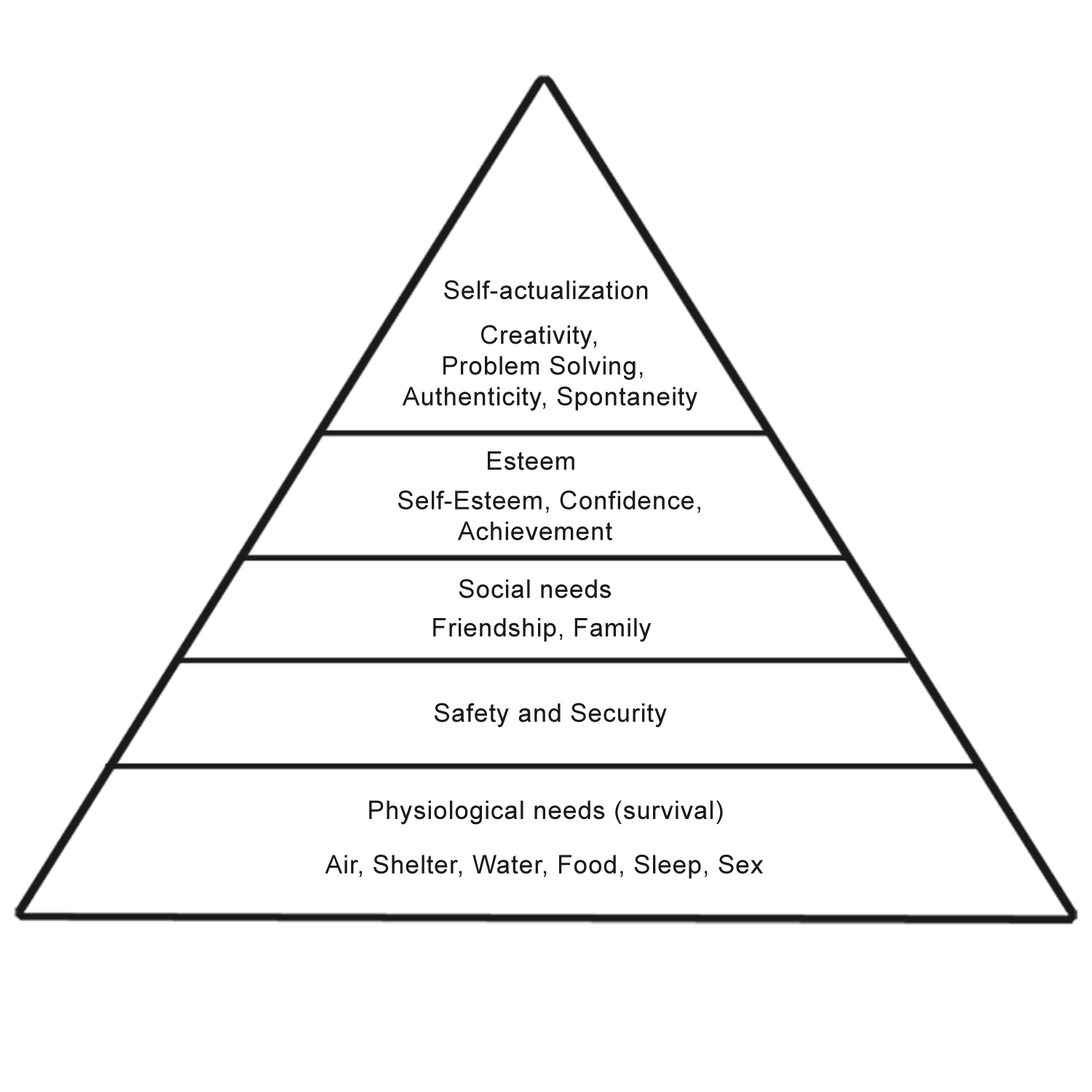
Basically, I think about what kinda' story I can tell in one second, make that the focus of the piece, and then tell all the secondary and tertiary stories in the details. A great way to understand the hierarchy of what people find most compelling is by looking at Maslow's pyramid of needs. Hint: Start from the base as the most fundamental and work your way up.

So, just to introduce you to the craft of storytelling I put together a few questions to ask yourself when creating an illustration:  

- What's the first thing people notice? This requires you to ask others, and is part of the "One Second Story." If you have a goblet of truth illuminated by some magical force and being held by a bare breasted woman who is shrouded in darkness, it doesn't matter how much you focus detail and light on the goblet. People will naturally try to look at the lady's breasts (Maslow's pyramid first level) because that's more compelling than your goblet of what-have-you (Maslow's pyramid 4th level). 

- What is so Compelling Here? I would refer to Maslow's pyramid when deciding how to capture attention. It is true that people tend to gravitate toward sex, but there are other things that make a compelling story (often having to do with survival). And it is possible to mix different levels of the pyramid to multiply the effectiveness of your story. 

- Why should people care? If your image tells a story at all, then why should people care about it? If it's a painting of some dude buying tools at a hardware store, the story is boring and nobody cares. But if his son is with him clearly struggling to help the guy buy different tools, then you have a more interesting image. (Maslow's pyramid third level) 
- Is there room for interpretation? I'm one of those people who believes in letting the viewer make up their own story. If the image is a stand alone piece then why not design it so everyone can decide what is happening for themselves. And if done properly, people will tend to come up with a more compelling story than you originally thought.

I hope that opens your mind a little to the idea that storytelling is very important to art. This week I'm putting the book recommendation at the end because this time it actually has something to do with the post. 

This book is for screenwriting but it also taught me a lot about how to tell a story. I can't tell you how invaluable the principles of this book have been in my art career. It seems strange, but sometimes the best knowledge comes from the strangest places.

Seriously give it a look

Story: by Robert McKee

And Next week, I want to go over story archetypes. It's going to be fun. thanks for reading!


Thursday, April 4, 2013

Engaging Other Humans at a Conference

Write down reminders about the conversation you have.

It's easy for artistic types to lock themselves in their rooms and avoid interacting with others. I know, they think differently then us and conform to social norms that seem superficial and foreign, but hiding away does you no good.  Besides, if you ever want to make a living at this, it behooves you to learn how to have a friendly conversation with a stranger while minimizing the creepy awkwardness.

Being someone who does do this for a living, I've had to overcome these social hurtles as every so often I find myself at a conference. Last week was the Game Developers Conference and met more people than I would naturally meet in a year. I've had my fare share of awkward conversations in the past (hell, I still do). but over the years (and with plenty of good advice) I've learned how to interact with humans in a conference environment. They are strange creatures, but rather friendly once you get to know them.

It can be easy to pass up an opportunity to talk to someone because you're nervous or shy, but once you know what to say it's not that hard. Think of it like a tennis match. Once you learn how to serve the ball, your opponent knows how to hit it right back. Conversations like this are a fun little game where the goal is to see if we should even be talking to each other in the first place. If the answer is yes, then you win the game by exchanging information.

A cold conversation can happen like this (cold, as in you're standing next to someone you don't know and decide to talk to them):

Me: Hey, my name's Garret AJ (extend hand for shake) 

Keven: Hey Garret, I'm Keven (Shakes my hand)

Me: Nice to meet you Keven, what do you do?
Keven: I work for a big company where I replace good programing with horse meat to cut back on cost.
Me: Oh sweet, I've heard of your company. Did they send you here on their behalf or are you here on your own... (and so on)


Now, at this stage I can decide if this guy is someone I need to talk to or not. If he is, I'll ask him to look at my portfolio while I question him more about what kind of skills it must take to do his job. Here's a list of things you can ask someone in these settings if you want to keep the conversation going.

  • Do you work here in town?
  • Where are you originally from?
  • What brought you to (insert conference here) 
  • I loved this product your company made (if you're familiar with the company work) 


Rule of thumb: Ask them about themselves. If the conversation migrates to you then let it happen. You're having a conversation after all. 

What if you want to end the conversation or realize you don't need to talk to this person as they're not in a position to employ you or get you employed? Here's some quick ways to end a conversation in a polite and reasonable way:

  • Well hey Keven, it was great meeting you. If I run into anyone in your field, I'll make sure to tell them about you. 
  • I got to get going to the (Horse meat) booth before the line gets too long, it was a pleasure meeting you. 
  • Well, I loved talking with you I hope (something pertinent to the conversation happens to you) your mother wins the lottery this time.
  • Thanks for talking with me, I got to go meet up with my group. I'll see you around the conference. 

Basically, just tell them you're moving on to the next thing. It seems like you could easily offend someone this way, but in this environment people know the deal. It's not even weird at all, they'll just say "Nice meeting you" and you go your separate ways.

So, let's just say you get along with someone and exchange information. Now what? Of course you move on to the next person, but if your on a mission to meet specific people, it would be efficient to find out where they are. In my case at the GDC, I spent most of my time near the career center where game companies had all their fun little booths set up to display all their different types of horse meat.

For artists in particular here are my best tips on how you should handle talking to people at the booths.

  1. Walk up and introduce yourself and ask if they are interested in talking to someone like you. "Hi, I'm Garret AJ, are you guys talking to concept artist?"
  2. Most likely they say yes and go into a spiel about their company. This is when you ask, "Is there anyone from the art team I can talk to."
  3. They answer yes or no. Yes means you talk to an art director or lead artist. No means you ask them if there will be anyone from the art team around today to talk to. 
  4. They answer your question, you take whatever swag or business cards they give you, and you go on your merry way. 

Why do I do this? Because, recruiters are nice, but they are almost useless to talk to if you're an artist (not saying there aren't some good recruiters out there). Often giving my card to a recruiter is the same a throwing it in the garbage. Recruiters are interested in collecting large amounts of information, and will ask for your resume or have you fill out an application. They can't tell between good art and bad, and they will not vouch for you because they have nothing to vouch for. They don't really know you or owe you anything. You're just another face in their long day of seeing faces.

That being said, do not avoid recruiters by any means. If you end up talking to one, be nice and hear them out. You never know where a good contact can come from.

However Ideally getting to the source is the way to go. Talk to art directors and be nice. Let them critique your work and give you ideas. Pay attention and remember details about the conversation. Then when you're done and on your way, go somewhere and write their name down and what you talked about. I personally like to use dot stickers to secure their business card over that information to make life easier later on (see pictures).

Then when you get home send them a short email saying you enjoyed meeting them at the conference and remind them of the conversation you had. "I was the guy who was asking about your horse meat." Make sure you tell them what the email is about. Job offer, contract work, following up with more information they requested, etc. Then cross your fingers and hope the get it.

Contacts I made with fellow artists.
As it comes to interacting with others in your field, all I can say is be nice, look at their work, wish them the best. Collect their card and connect with them on Facebook.They are not your enemy and don't treat them like competition. They are someone just like you on their own path and you should be commiserating and supporting your fellow travelers. And like I said before, you never know where a good contact can come from.

And there you have it. It's not hard at all once you get the hang of it. And if you have a friend who knows the routine see if they can wing-man you on a few interactions before you get it down. 

I hope that helps, and I wish you happy hunting.

Thanks for reading.


NEVER argue with Critiques. Listen to what they say and write it down.

If someone runs out of cards, gather enough info so you can look them up later.


Thursday, March 28, 2013

Sorry (GDC)

Sorry, no blog this week. I am sleeping on a couch at a friends house in San Fransisco while I attend the GDC conference. How can I make this up to you? I will try to make next week extra special, OK?